
The NYC subway made simple — for first-time visitors and tourists.
Getting around New York City by subway is the fastest, cheapest, and most local way to explore the city — but it can feel overwhelming if you've never used it before. This guide is built for first-time visitors and tourists who want simple, clear directions between NYC's most popular attractions, without having to decode a subway map or download another app.
Use the interactive tool above to get step-by-step subway directions between 16 top NYC destinations, including Times Square, Central Park, the 9/11 Memorial, Brooklyn Bridge, the Empire State Building, and more. Every route includes which train to take, which platform to use, and a direct link to walking directions to the station entrance.
The New York City subway runs 24 hours a day, 7 days a week, making it one of the most accessible transit systems in the world. A single ride costs $3.00 and takes you anywhere in Manhattan, Brooklyn, Queens, or the Bronx — no matter how far you're going.
Here is what every tourist needs to know before their first subway ride:
.webp)
Pay with your phone or card. As of 2026, MetroCards have been retired. The MTA now uses OMNY — simply tap your contactless credit card, debit card, Apple Pay, or Google Pay at the turnstile and go. No card to buy, no machine to figure out. If you prefer a dedicated card, you can purchase an OMNY card at any station for $5.
Uptown means north, downtown means south. When you're looking for your platform, signs will say "Uptown" or "Downtown." Uptown takes you toward the Bronx and upper Manhattan — higher street numbers. Downtown takes you toward Lower Manhattan and Brooklyn — lower street numbers. If you're going from Times Square to Central Park, you want uptown. If you're going from Central Park to the 9/11 Memorial, you want downtown.
Know the difference between local and express trains. Local trains stop at every station. Express trains skip many stops and are faster for longer distances. On the subway map, black dots are local stops and white dots are express stops. The 4 and 5 trains, for example, are express — they're significantly faster than the 6 for long distances.
Always check the destination board on the platform. The front of every train displays its final destination. Always confirm you're boarding the right train going in the right direction before the doors close.
Use the directions tool above to plan your route. Every route in the tool above is written specifically for tourists — plain language, step-by-step, with the correct platform, train, and walking directions to each station entrance included.
Avoid rush hour if you can. Weekday mornings between 8am and 9:30am, and afternoons between 4:30pm and 7pm, are the busiest periods on the subway. Platforms are crowded, trains are packed, and delays are more common. If your itinerary is flexible, plan major sightseeing trips for mid-morning or early afternoon on weekdays, or weekend mornings.
The 4 and 5 express trains are your best friends for crossing Manhattan quickly. They run between the Bronx and Brooklyn, stopping at major hubs but skipping many local stations. If you need to get from the Financial District to the Upper East Side or Harlem, the 4/5 express is significantly faster than the 6 local.
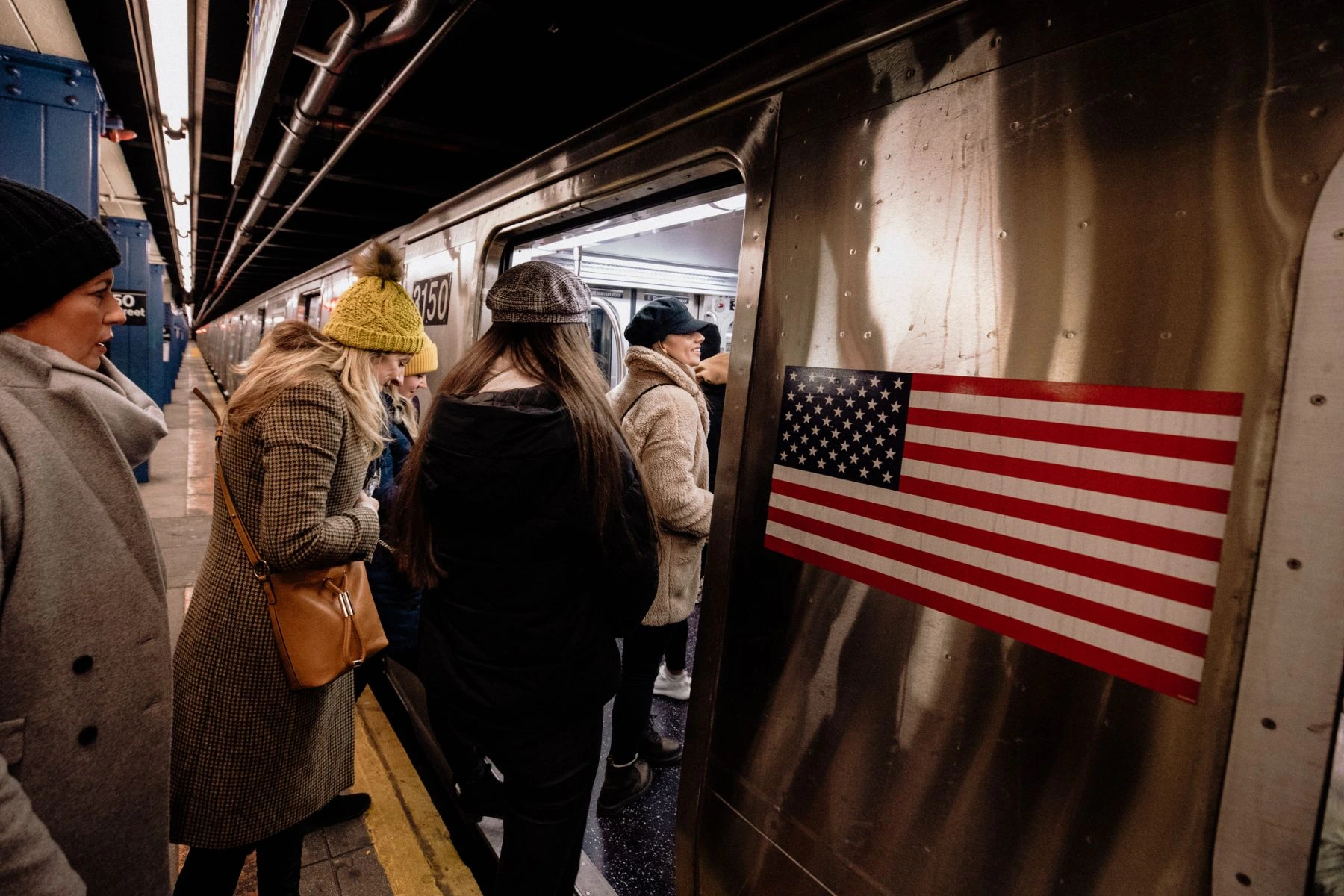
Weekend service is different. The MTA runs reduced and modified service on weekends, and many lines are rerouted due to maintenance work. The direction tool above is based on standard weekday service — always check the MTA app or mta.info for weekend service changes before you travel.
There is no day pass for the NYC subway. Unlike many cities, New York does not offer a 24-hour unlimited transit pass. However, OMNY's weekly cap means that after 12 rides in a seven-day period (totaling $34.80), all remaining rides in that week are free. If you're in the city for several days, this is effectively an unlimited pass.
The subway does run 24 hours, but late-night trains are slower and less frequent. After midnight, many express lines run local, and trains may come every 20 to 30 minutes. Plan accordingly if you're returning from a late dinner or show.
Stand clear of the closing doors. Seriously. Holding the doors delays the entire train and can result in a service disruption. New York moves fast — if you miss a train, another is coming.
The interactive subway navigator above covers directions between 16 of New York City's most visited destinations. Here's a quick overview of each location and which subway lines serve them.
Times Square — The heart of Midtown Manhattan. Served by the 1/2/3, A/C/E, N/Q/R/W, and 7 trains at 42nd Street. The most connected subway hub in the city.
Central Park — Enter at Columbus Circle (59th Street) from the south, served by the 1, A, C, B, and D trains. The B and D trains also stop along the western edge of the park at 72nd, 81st, and 86th Streets.
9/11 Memorial & Museum — Served by the 1 train at WTC Cortlandt Street, and the 2/3/4/5/A/C at Fulton Street. The E train terminates at the World Trade Center station underground.
One World Observatory — Same station complex as the 9/11 Memorial. The E train stops directly at the World Trade Center, putting you at the base of the building.
Brooklyn Bridge / DUMBO — Take the 4/5/6 to Brooklyn Bridge–City Hall, or the J/Z to Chambers Street. From DUMBO, the F train to York Street is the most scenic option.
Empire State Building — Served by the B/D/F/M/N/Q/R/W at 34th Street–Herald Square on 6th Avenue, and the 6 at 33rd Street on Lexington Avenue.
The Met / Museum Mile — Take the 4 or 5 express to 86th Street on Lexington Avenue, then walk four blocks west to 5th Avenue. The 86th Street station is the closest to the museum's main entrance.
Rockefeller Center — Served by the B/D/F/M at 47–50th Streets–Rockefeller Center station on 6th Avenue. This stop deposits you directly at the plaza.
SoHo & Little Italy — Use Spring Street (C/E) on 6th Avenue, or Prince Street (N/R/W) on Broadway. Spring Street puts you on the western edge of SoHo, closest to the boutiques.
High Line — Enter the park from the A/C/E at 14th Street on 8th Avenue, or the C/E at 23rd Street. The High Line's main southern entrance is on Gansevoort Street at Washington Street.
Grand Central Terminal — Served by the 4/5/6, 7, and S shuttle at 42nd Street. The S shuttle connects directly to Times Square in two stops.
Statue of Liberty & Battery Park — Take the 4/5 to Bowling Green, or the N/R/W to Whitehall Street–South Ferry. The Statue of Liberty ferry departs from Battery Park at the southern tip of Manhattan.
Chinatown & Lower East Side — Use Canal Street, served by the J/N/Q/R/Z/6 on the east side, or the A/C/E on the west side. Canal Street is the main artery through both neighborhoods.
Harlem — The A/B/C/D stop at 125th Street and St. Nicholas Avenue is the main Harlem hub on the west side. The 2/3 stop at 125th Street and Lenox Avenue serves the east side.
Yankee Stadium — Take the 4, B, or D train to 161st Street–Yankee Stadium. The station exits directly onto the plaza outside the stadium gates.
Coney Island — Take the D, F, N, or Q train to Coney Island–Stillwell Avenue. All four lines terminate there. The boardwalk is a two-minute walk from the station exit.