
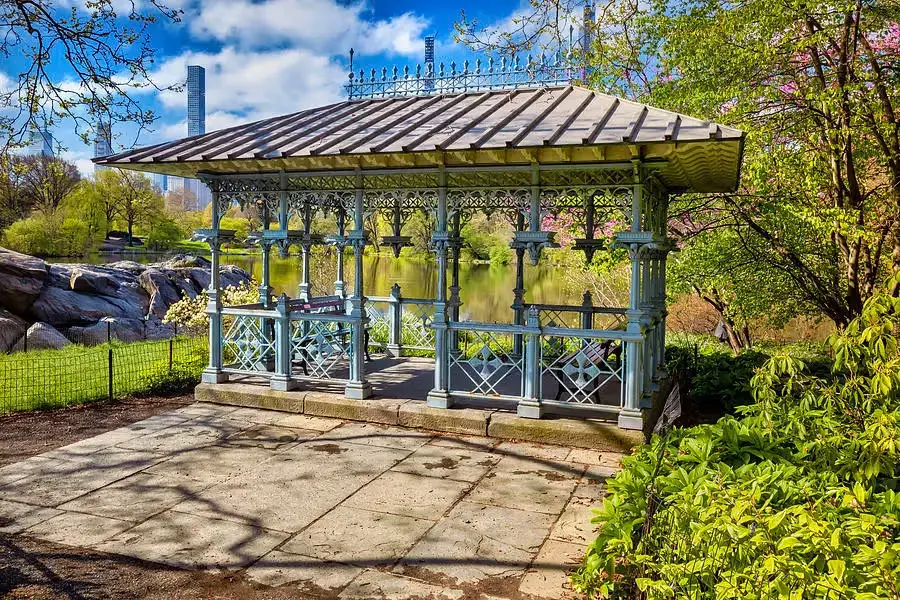
A filigreed Victorian cast-iron shelter on the rocky promontory of Hernshead, extending over the west side of the Lake — one of the most ornate and least-visited structures in Central Park, with exceptional views back across the water toward Bow Bridge.


A filigreed Victorian cast-iron shelter on the rocky promontory of Hernshead, extending into the west side of the Lake. Built in 1871, originally sited at 59th Street and 7th Avenue as a shelter for visitors waiting for horse-drawn street cars. Relocated to its current position in 1912. One of the most overlooked romantic spots in the park — the pavilion extends over the water on three sides, the ironwork is among the most detailed in the park, and the view back toward the Lake and Bow Bridge is consistently excellent. Popular as a micro-wedding and proposal venue. Open 24 hours. Free.
Late afternoon in October — the surrounding trees turn and reflect in the Lake below the promontory. The pavilion is almost always quiet regardless of season.
The pavilion was originally built at 59th Street and 7th Avenue as a streetcar shelter in 1871 — it was relocated to Hernshead in 1912 when the streetcars were removed. Look at the ironwork closely: the detail level is unusual for something originally built as a functional transit shelter, not a decorative structure.
A filigreed Victorian cast-iron shelter on the rocky promontory of Hernshead, extending into the west side of the Lake. Built in 1871, originally sited at 59th Street and 7th Avenue as a shelter for visitors waiting for horse-drawn street cars. Relocated to its current position in 1912. One of the most overlooked romantic spots in the park — the pavilion extends over the water on three sides, the ironwork is among the most detailed in the park, and the view back toward the Lake and Bow Bridge is consistently excellent. Popular as a micro-wedding and proposal venue. Open 24 hours. Free.

.webp)


.webp)
%20(1).webp)
.webp)