


.webp)
Few places in New York City capture the imagination quite like Bethesda Terrace and Fountain. Nestled at the heart of Central Park, this breathtaking landmark draws millions of visitors each year — many of whom explore it as part of a Central Park tour — with its sweeping views, extraordinary architecture, and storied past.
Whether you're a first-time visitor or a lifelong New Yorker, Bethesda Terrace offers something remarkable at every turn.
What Is Bethesda Terrace?
Bethesda Terrace is a grand two-level plaza located at the northern end of the Central Park Mall, near the 72nd Street Cross Drive. It sits at the convergence of some of the park's most beloved natural features — overlooking the Lake to the north, the Ramble beyond, and the elm-lined promenade of the Mall to the south. Designed by architect Calvert Vaux and his talented collaborator Jacob Wrey Mould, Bethesda Terrace was envisioned as Central Park's architectural centerpiece — a formal, ornate counterpoint to the naturalistic landscape that surrounds it.
.webp)
Vaux famously declared that his philosophy was "Nature first, second, and third — architecture after a while." Yet Bethesda Terrace was his masterpiece, the one structure where architecture and nature were brought into a deliberate, spectacular harmony. Many consider it a secular outdoor cathedral, rich with iconography and unmatched in 19th-century public art.
The terrace consists of two distinct levels connected by grand sweeping staircases and a central arcade. The upper level carries the carriage road corresponding to 72nd Street, while the lower level — known as the Esplanade — is a broad flagstone plaza that frames Bethesda Fountain at its center. The construction of Bethesda Terrace began in 1859, with the stonework largely completed by the mid-1860s. The entire complex, including the fountain, was officially finished in 1873.

The Arcade: A One-of-a-Kind Marvel
One of the most remarkable architectural features of Bethesda Terrace is its Arcade — the passageway connecting the upper and lower levels beneath the 72nd Street drive. It functions similarly to the park's many bridges and arches, allowing pedestrians to cross underneath the carriage road in shelter and style.
.webp)
What makes the Arcade truly unique is its ceiling. Comprising nearly 16,000 encaustic Minton tiles — manufactured by the Minton tile company in Stoke-on-Trent, England — the ceiling forms 49 elaborate geometric panels. Remarkably, it is the only ceiling in the world to feature Minton encaustic tiles, which were traditionally used as flooring. Jacob Wrey Mould designed the intricate tile patterns, which bathe the arcade in rich color and pattern.
.webp)
Over time, the weight of the ceiling and the effects of weather caused significant deterioration. In the 1980s, the Central Park Conservancy removed the tiles for safekeeping. After decades of storage and fundraising, a $7 million restoration project was launched in 2004, and the restored tiles were reinstalled in 2007 — bringing this extraordinary work of art back to its full glory.
The Architectural Details: Carvings by Jacob Wrey Mould
Every surface of Bethesda Terrace tells a story. Jacob Wrey Mould, a classically trained English architect who served as Vaux's close collaborator, designed an elaborate sculptural program woven throughout the terrace's ramps, balustrades, and piers.
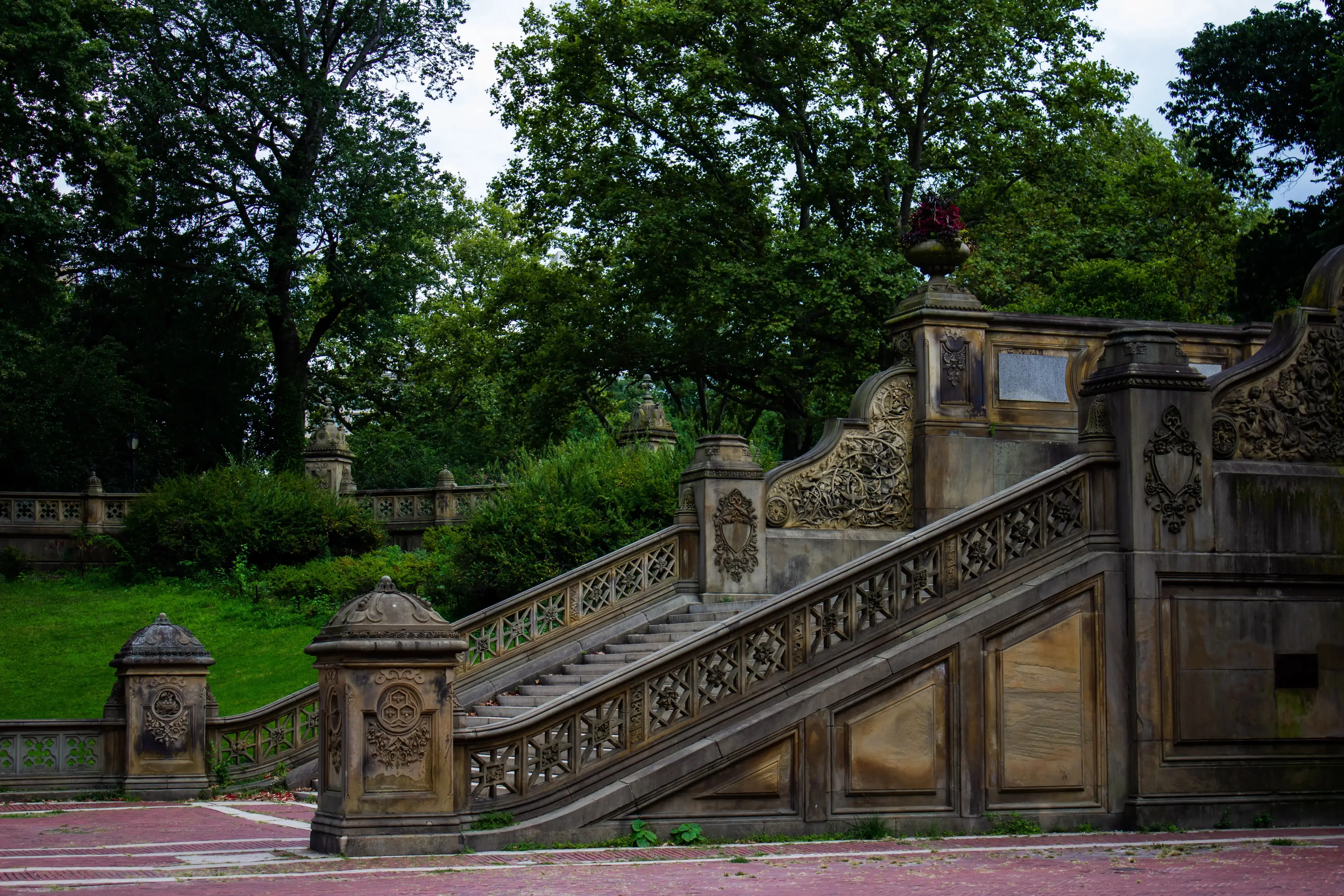
The carvings follow an intricate iconographic program reflecting the themes of the seasons, times of day, ages of mankind, nature, science, and art. On the upper level, piers feature scenes representing night and day. The grand staircases are adorned with beautifully rendered depictions of the four seasons — delicate fruit, flowers, plants, and birds carved in stone. Details include lambs' heads for spring, butterflies and berries for summer, holly leaves and pine cones for fall, and firewood for winter. A rooster symbolizes the longer days of spring and summer, while ice skates evoke winter. Originally, Vaux and Mould planned for bronze figures to accompany these carvings, but they were never executed.
The balustrades and stonework are crafted from New Brunswick sandstone, with granite steps and landings, and herringbone paving of Roman brick laid on edge — materials chosen both for their beauty and durability.
Bethesda Fountain: Angel of the Waters
At the center of Bethesda Terrace stands one of Central Park's most beloved works of art: Bethesda Fountain, also known as the Angel of the Waters. The fountain was designed by sculptor Emma Stebbins in 1868 and unveiled at a public dedication in 1873. It holds a unique distinction: it is the only artwork in Central Park's collection that was commissioned by the park's designers and administrators, rather than donated.
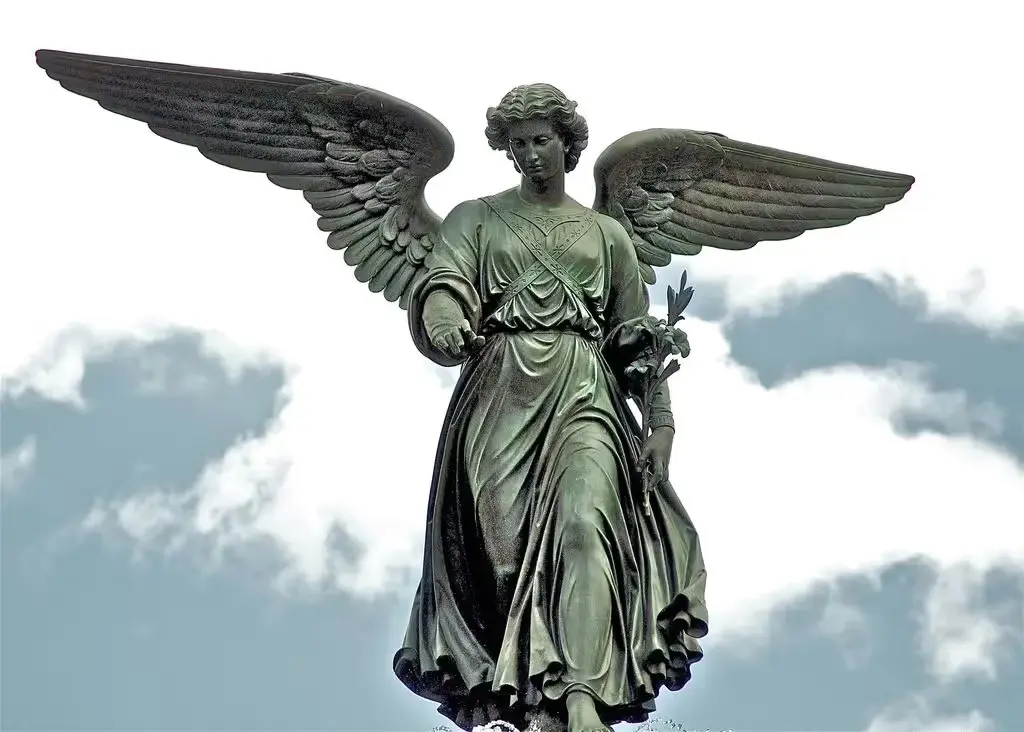
The fountain's bronze statue depicts an eight-foot winged angel descending gracefully onto the top of a two-tiered basin. Water spouts around her feet and cascades down into a large circular pool below. At the base of the pedestal stand four smaller cherubs, each representing one of the statue's symbolic themes: temperance, purity, health, and peace.
The angel holds a lily in one hand — a symbol of purity — while with her other hand she blesses the water below. The iconography was inspired by a passage from the Gospel of John describing an angel who blessed the Pool of Bethesda, giving it healing powers. The fountain was created to commemorate the opening of the Croton Aqueduct in 1842, which first brought clean, fresh water to New York City — a genuine act of healing for a city that had suffered devastating outbreaks of waterborne disease.

The lower basin of Bethesda Fountain is filled with aquatic plants during the summer months, including water lilies, lotus, and papyrus — a detail inspired by an 1891 book by Samuel Parsons, the Superintendent of Planting in Central Park. The base of the fountain was designed by Calvert Vaux, with sculptural details again contributed by Mould.
Emma Stebbins made history as the first woman to receive a public art commission in New York City, and her Angel of the Waters remains one of the most recognized and admired works of public sculpture in the United States.
A Turbulent Past and Triumphant Restoration
Bethesda Terrace and Fountain have not always been the immaculate landmark visitors see today. By the late 1970s, the terrace had fallen into serious disrepair — stonework cracked and crumbled, the arcade ceiling leaked, and Bethesda Fountain ran completely dry. The terrace became a focal point for the city's struggles with crime and neglect during that difficult decade.
The Central Park Conservancy, founded in 1980, chose Bethesda Fountain as the very first target of its restoration campaign. The fountain was brought back to life in 1980–1981, and the terrace itself was restored the following year — its stonework carefully disassembled, cleaned, repaired, and reset. Extensive replanting followed, including 50 new trees and thousands of shrubs and ground cover plants. The Minton tile ceiling restoration was completed in 2007. Today, the Central Park Conservancy continues to maintain the terrace and fountain as part of its stewardship of the entire park.
Bethesda Terrace on the Silver Screen
Over the decades, Bethesda Terrace and Fountain have become one of the most filmed locations in New York City. The dramatic backdrop of the fountain and terrace has appeared in countless films and television series, including When Harry Met Sally, Home Alone 2, Elf, Enchanted, Angels in America, Gossip Girl, Sex and the City, and many others. Its combination of natural beauty, architectural grandeur, and cultural resonance makes it an irresistible setting for storytellers of every kind.
Visiting Bethesda Terrace and Fountain
Bethesda Terrace is open to the public year-round and is free to visit. To reach it, enter Central Park at 72nd Street from either Central Park West or Fifth Avenue and walk toward the center of the park. The terrace is close to the Central Park Mall, Literary Walk, and the Loeb Boathouse — making it easy to combine multiple park highlights in a single visit — especially if you're exploring by Central Park pedicab tour.
Restrooms on the terrace are open from 6:30 AM to 9:00 PM daily, late March through early November.
Whether you visit at dawn with the mist rising off the Lake, on a bright summer afternoon with the fountain in full flow, or on a crisp autumn evening when the trees surrounding the terrace turn gold, Bethesda Terrace and Fountain offer a timeless, unforgettable Central Park experience.