.webp)
Of all the iconic landmarks scattered across Central Park, few capture the romance and elegance of New York City quite like Bow Bridge. Stretching gracefully over the Lake between Cherry Hill and the Ramble, this Victorian cast iron bridge has been a beloved destination for visitors, photographers, couples, and dreamers since it was completed in 1862.
Whether you're visiting for the first time or returning for the hundredth, Bow Bridge never fails to impress.
What Is Bow Bridge?
Bow Bridge is a cast iron bridge in Central Park, spanning the Lake as a pedestrian walkway between the Cherry Hill area to the west and the Ramble to the east. Its name comes from its distinctive silhouette — a low, graceful arc that resembles the bow of an archer or a violinist's bow. At 87 feet long, it holds the distinction of being the longest of Central Park's ornamental bridges, with a full balustrade stretching 142 feet.
Unlike most of the park's other bridges, which were designed to blend quietly into their surroundings, Bow Bridge was intentionally built to stand out. It is also the only one of Central Park's seven ornamental iron bridges that does not cross a bridle path — a detail that speaks to how carefully each structure was tailored to its specific location and purpose.
.webp)
Who Designed Bow Bridge?
Bow Bridge was designed by Calvert Vaux and Jacob Wrey Mould — the same duo responsible for the extraordinary architectural details of Bethesda Terrace, Central Park's grand formal centerpiece. Construction was carried out by the Bronx-based iron foundry Janes, Kirtland & Co., the very same firm that built the dome of the U.S. Capitol Building. The bridge was completed in 1862, making it one of the oldest cast iron bridges in America.

Vaux and Mould's design reflects the full sophistication of Victorian-era craftsmanship. The bridge is adorned with an interlocking circles banister and eight decorative planting urns mounted on bas-relief panels. Underneath the arch, intricate arabesque elements and volutes add further depth and artistry. The walkway itself is made from ipe, a dense South American hardwood that takes on a deep, rich red tone when wet. The overall effect blends classical Greek refinement with Gothic, Neo-Classical, and Renaissance influences — a fitting complement to the naturalistic landscape that surrounds it.
Bow Bridge as Part of Central Park's Design
To truly appreciate Bow Bridge, it helps to understand the grand vision behind Central Park itself. Designers Frederick Law Olmsted and Calvert Vaux developed an intricate circulation system for the park — weaving together pedestrian paths, a bridle path, and carriage drives in a way that allowed thousands of visitors to move through the landscape without conflicting with one another. Bridges and arches were a critical part of this system, carrying one form of traffic safely over another.
Between 1859 and 1866, 27 arches and bridges were built across Central Park, all designed by Vaux, often with contributions from Jacob Wrey Mould. Each one is unique in material, decorative motif, and relationship to its surrounding landscape. Today there are 30 ornamental bridges and arches in the park in total.

Bow Bridge was created as one of the primary entrances to the Ramble — the park's beloved woodland wilderness — and as a connecting route toward Bethesda Terrace to the south. Its placement over the Lake was deliberate, maximizing views across the water in both directions and giving it an unmatched sense of openness and drama.
The Views from Bow Bridge
Standing at the center of Bow Bridge, you're treated to some of the most sweeping and peaceful views in all of Central Park. To the south, the Lake stretches toward Cherry Hill and the skyline of Central Park West rises beyond the trees. To the north, the Ramble's dense woodland canopy creates the impression of being deep in a forest, far removed from the city around you.
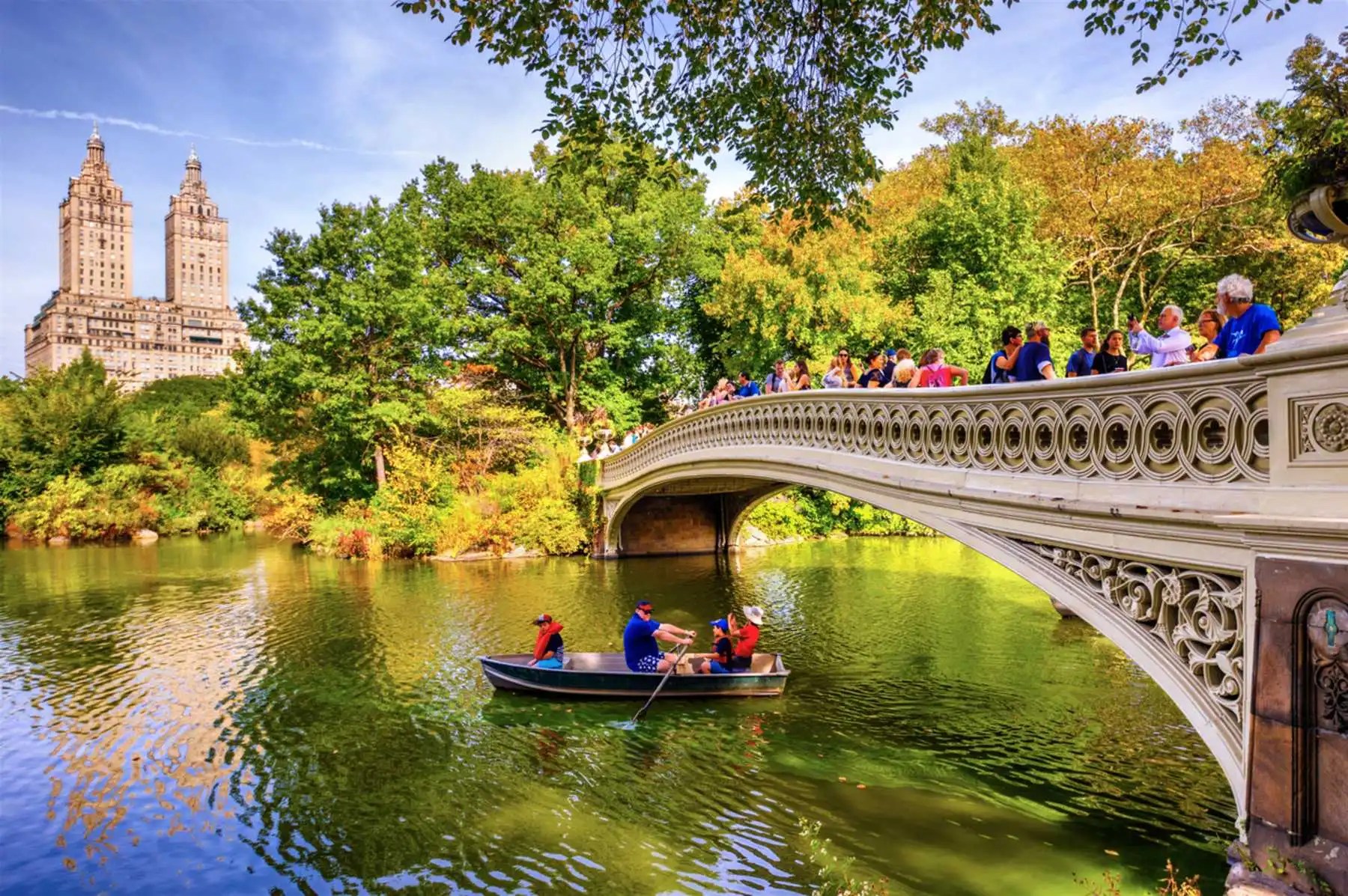
At different times of year, the bridge offers entirely different experiences. In spring, cherry blossoms frame the shoreline. Summer brings lush green foliage and rowboats drifting across the water. Autumn transforms the surrounding trees into a blazing tapestry of red, orange, and gold — arguably the most photographed version of the bridge. In winter, when snow settles on the ironwork and the Lake lies still and grey, Bow Bridge takes on an almost cinematic quality.
It's no surprise that the bridge has appeared in dozens of films and television shows over the decades, becoming one of the most recognized outdoor locations in New York City.
The Most Romantic Spot in Central Park
Bow Bridge has long been considered one of the most romantic spots in New York City — and arguably in the entire country. It's a favored location for wedding proposals, engagement photos, and anniversary celebrations. The combination of the graceful iron arch, the still waters below, the surrounding trees, and the distant city skyline creates an atmosphere that feels both intimate and grand.
One popular way to experience the bridge's romance is from the water itself. Renting a rowboat from the nearby Loeb Boathouse and drifting underneath the arch offers a completely different and unforgettable perspective. The Lake is dotted with hidden alcoves along its shores, making for a peaceful and private adventure on the water.

History and Restoration
Despite its enduring elegance, Bow Bridge has required significant care over the years. By the early 1970s, the bridge had deteriorated considerably and underwent a major restoration in 1974. Decades later, in November 2023, the bridge was closed again for a two-month renovation — a reminder of the ongoing commitment required to preserve Central Park's most cherished landmarks.
The Central Park Conservancy, the nonprofit organization responsible for managing and maintaining the park, oversees the stewardship of Bow Bridge along with the park's other 29 ornamental bridges and arches.
How to Get to Bow Bridge
The most straightforward route to Bow Bridge is to enter Central Park at the Women's Gate at 72nd Street and Central Park West. From there, follow Terrace Drive east toward Cherry Hill — you'll spot the bridge just to the northeast of Cherry Hill fountain. By subway, the closest station is 72nd Street on the A, B, and C lines.
The bridge is open to pedestrians year-round and free to visit. It pairs naturally with a stroll along the Mall, a visit to Bethesda Terrace, and a stop at the Loeb Boathouse for a meal or a boat rental. If you want to cover more ground and take in multiple park highlights in a single outing, exploring by Central Park pedicab tour is a great way to see Bow Bridge alongside other landmarks without spending all day on your feet. For a full overview of ways to experience the park, browsing a Central Park tours guide can help you plan the perfect visit.
A Living Landmark
More than 160 years after its completion, Bow Bridge in Central Park remains as captivating as ever. It is a testament to the vision of Calvert Vaux, the craftsmanship of Jacob Wrey Mould, and the extraordinary ambition of Central Park's original designers. Whether you cross it on foot, admire it from a rowboat, or simply pause to take in the view, Bow Bridge is one of those rare places in New York City that genuinely earns its reputation as unmissable.
.jpg)