Central Park is 843 acres, which is bigger than it looks on a map and much bigger than it feels from Fifth Avenue. Most visitors have a few hours, not a day, and the difference between a great visit and a frustrating one is knowing which entrance to use and which route fits the time you actually have.
This guide answers the questions our guides get asked most, in order: how big the park is, how long it takes to walk, which Central Park entrance to start from, and then three walking routes for one, two, and three hours, each covering the must-see landmarks in a sensible order with a map you can follow. At the end, an honest look at the best way to see Central Park if you'd rather not walk it all.
How big is Central Park?
Central Park covers 843 acres, or about 1.3 square miles. It runs 2.5 miles from 59th Street to 110th Street and half a mile from Fifth Avenue to Central Park West. For scale, that's larger than the country of Monaco, roughly the size of 600 football fields, and about six percent of Manhattan.
.jpg)
Inside those boundaries are 58 miles of pedestrian paths, seven bodies of water, 36 bridges and arches, more than 20,000 trees, and a six-mile loop road that circles the whole thing. The park is open every day from 6 a.m. to 1 a.m. and is free to enter.
The number that matters for planning is the 2.5-mile length. Walking from the south end to the north end takes about an hour without stopping, and nearly everything famous is in the southern half, below 79th Street. That's why every route below starts at the south and works north, and why a first visit doesn't need to reach the top of the park at all.
How long does it take to walk Central Park?
It depends what you mean by "walk Central Park," so here are the honest numbers:
- End to end, 59th to 110th Street, no stops: about 1 hour, 2.5 miles.
- The Central Park loop, the full outer drive: 6.1 miles, about 2 to 2.5 hours on foot, 30 to 45 minutes by bike.
- The southern highlights on foot, with stops: 1.5 to 2 hours. This is what most visitors actually want, and it's the two-hour route below.
- Every major landmark in the park: a full day, 8 to 12 miles.
Most people underestimate the park and overestimate their legs. The paths curve, the landmarks aren't in a straight line, and the two most photographed spots, Bethesda Terrace and Bow Bridge, are already a mile in from the nearest Midtown entrance. Plan by landmarks, not by miles, and pick the route that matches your time.
Which Central Park entrance should you use?
The park has 18 named gates, and the right Central Park entrance depends on where you're coming from and what you want to see first.
- Grand Army Plaza (Fifth Avenue and 59th Street), southeast corner. The best starting point for all three routes below. It's beside the Plaza Hotel, steps from the N, R, and W trains, and it drops you at the Pond and Gapstow Bridge within three minutes.
.jpg)
- Merchants' Gate at Columbus Circle (59th Street and Central Park West), southwest corner. Closest to Times Square and the A, B, C, D, and 1 trains. It leads to Heckscher Playground, Sheep Meadow, and the west side of the Mall. Pedicab tours depart from just outside it.
- 72nd Street and Central Park West. Enter here if you're short on time and want Strawberry Fields, Bow Bridge, and Bethesda Terrace with the least walking. The B and C trains stop at the gate.
- 79th or 81st Street and Central Park West. For Belvedere Castle, Shakespeare's Garden, and the Great Lawn, or if you're pairing the park with the American Museum of Natural History.
- Fifth Avenue and 82nd Street. The Met's front door; the Obelisk and the Great Lawn are directly behind it.
If you only remember one: start at Grand Army Plaza and walk north. Everything else follows.
Central Park in 1 hour: the highlights walking route
This route covers the five things everyone comes for in about 1.5 miles. It's also the route a one-hour Central Park pedicab tour follows, if you'd rather ride it.
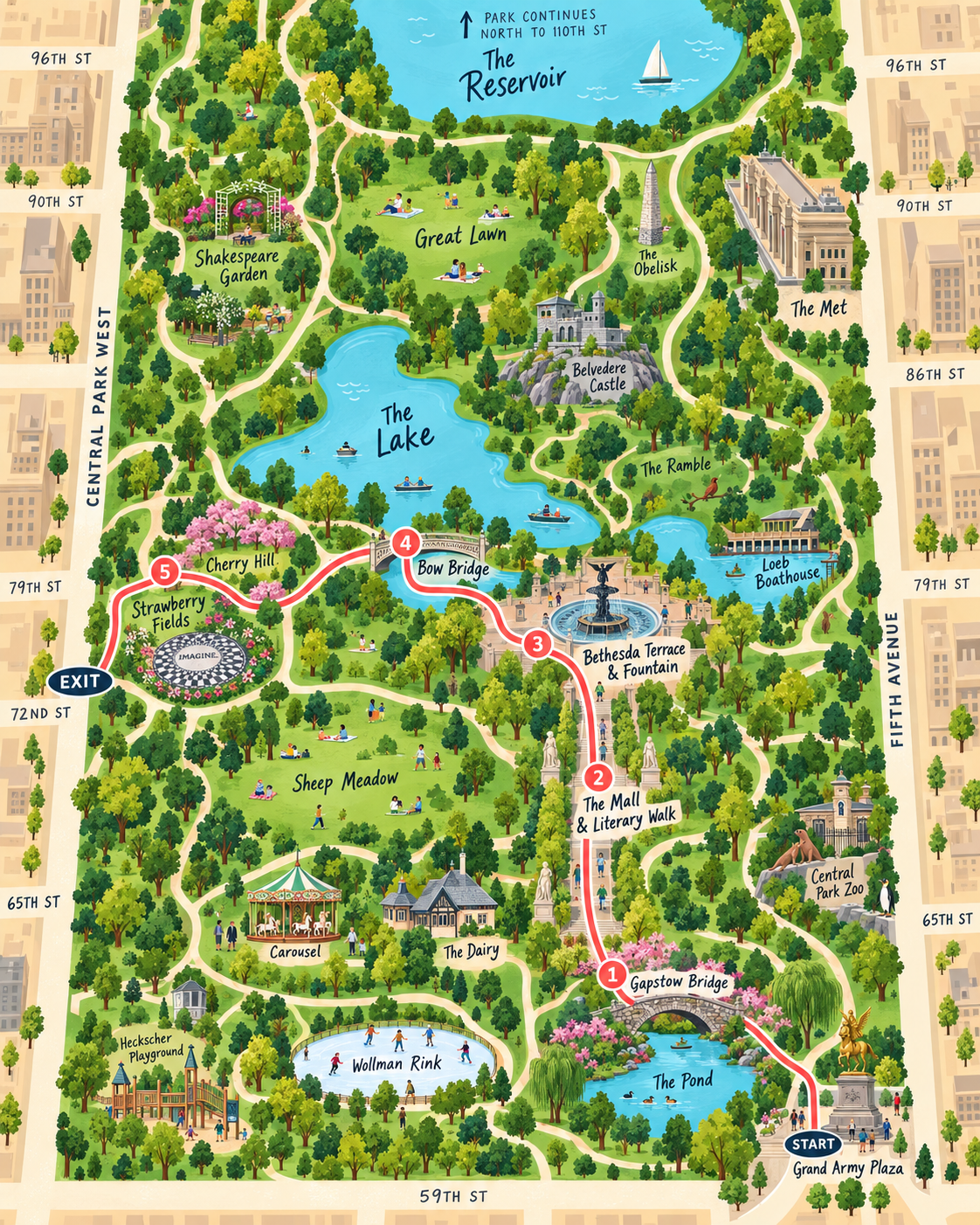
- Gapstow Bridge (5 min in). Turn left at the Pond and stand on the southeast bank for the postcard view of the stone bridge with the Plaza and the Midtown skyline behind it. This is the Home Alone 2 bridge.
- The Mall and Literary Walk (15 min). Walk north under the elm canopy past the statues of Shakespeare and Burns. It's the park's only straight path and its most photographed autumn scene.
- Bethesda Terrace and Fountain (25 min). The Mall ends at the terrace. Go down through the tiled arcade, out to the Angel of the Waters fountain, and you're at the center of the park and its most filmed location.
- Bow Bridge (35 min). Three minutes west along the Lake. Cross it, look back at the Central Park West skyline, then return.
- Cherry Hill and Strawberry Fields (45 min). Climb to the Cherry Hill fountain for the best photo of Bow Bridge, then continue west to the Imagine mosaic at Strawberry Fields, with the Dakota across the street.
You'll exit at 72nd Street having seen the park's core. If you have a spare 15 minutes, the Loeb Boathouse is a short detour east from Bethesda for coffee by the water.
Central Park in 2 hours: highlights plus the Ramble and Belvedere Castle
The two-hour Central Park walking route does everything above and then goes into the park's wildest and highest sections, about 2.5 miles in total.
Map: Grand Army Plaza → Gapstow Bridge → the Mall → Bethesda Terrace → Bow Bridge → the Ramble → Belvedere Castle → Shakespeare's Garden → Turtle Pond and the Great Lawn → exit at 81st Street and Central Park West.
Follow the one-hour route to Bow Bridge, but this time keep going across it.
- The Ramble (55 min). On the far side of Bow Bridge, 36 acres of winding woodland paths, streams, and rock outcrops, designed to make you lose your bearings. It's the best birdwatching in Manhattan. Keep heading generally north and uphill; every path eventually leads to the castle.
- Belvedere Castle (1 hr 20 min). Calvert Vaux's 1869 folly on Vista Rock, free to enter, with the best elevated view in the park over Turtle Pond and the Great Lawn. It's also the official Central Park weather station.
- Shakespeare's Garden (1 hr 35 min). Just below the castle to the west, a hillside garden of plants from the plays, with the Whisper Bench at its edge.
- Turtle Pond and the Great Lawn (1 hr 45 min). Walk down past the Delacorte Theater to the 55-acre lawn, then west to the 81st Street exit, beside the Natural History Museum.
This is the route to choose for a first visit if you have the time. It covers the famous landmarks and the part of the park that feels like the countryside.
Central Park in 3 hours: the full southern park and the Reservoir
Three hours lets you see almost everything worth seeing below 96th Street, about four miles, and finish on the east side by the Met.
Map: Grand Army Plaza → Gapstow Bridge → the Mall → Bethesda Terrace → Bow Bridge → the Ramble → Belvedere Castle → the Great Lawn → the Obelisk → the Reservoir (south and east edge) → exit at Fifth Avenue and 86th or 90th Street.
Follow the two-hour route to the Great Lawn, then instead of exiting west, cross the lawn to the east.
- The Obelisk, Cleopatra's Needle (2 hrs 5 min). A 3,500-year-old Egyptian obelisk, the oldest man-made object in the park, standing behind the Met.
- The Reservoir (2 hrs 20 min). Join the 1.58-mile running path at its southeast corner and walk counterclockwise along the south and east edges for the skyline views across the water. In April this stretch is lined with cherry blossoms.
- Exit at Fifth Avenue (2 hrs 50 min). Leave at 86th or 90th Street for the 4, 5, and 6 trains, or double back to the Met at 82nd Street if you're ending the day at the museum.
If you'd rather stay south, swap the Reservoir for the Central Park Zoo, the Carousel, and the Dairy, which cluster near 64th Street and add an hour for families.
What is the best way to see Central Park?
Walking is the honest default: it's free, it's the way the park was designed to be seen, and every route above is walkable in ordinary shoes. But it isn't the only way, and it isn't the right way for everyone.
- Walk if you have two hours or more, like to wander, and want to go into the Ramble, where nothing with wheels can follow.
- Central Park pedicab tour if you have an hour, want the highlights with a guide telling the story at each stop, or are with children, older family, or anyone who'd rather not cover three miles. A one-hour pedicab covers the two-hour walking route and stops for photos.
- Bike if you want the six-mile Central Park loop and the exercise. Bikes stay on the drives and can't reach Bethesda Terrace or Bow Bridge directly.
- Central Park walking tour if you want the history and a set route without navigating; most run two hours and stay below 79th Street.
- Horse carriage if you want the ride itself; carriages follow a short loop in the southern park and don't reach most of the landmarks above.
A lot of visitors combine two: a pedicab tour to see the layout with a guide, then a walk back through the sections they liked. If you're choosing one, walk with two hours or more, ride with less.
Central Park must-see checklist
Whatever route you take, these are the things to see in Central Park that make a visit feel complete: Gapstow Bridge for the skyline, the Mall for the elms, Bethesda Terrace and Fountain for the center of it all, Bow Bridge for the view, Strawberry Fields for the mosaic, and Belvedere Castle for the height. Everything else is a bonus.
If you'd like to see all of it in an hour with someone who knows every stop, our Central Park pedicab tours follow this exact route from Columbus Circle, with photo stops at each landmark and a guide who'll tell you what you're looking at. They run every 30 minutes from 8 a.m. to 6 p.m., from $29 per person.
Frequently Asked about
Central Park
How big is Central Park?
How long does it take to walk through Central Park?
Which entrance to Central Park is best?
Can you see Central Park in one hour?
Is Central Park free, and what are its hours?
.webp)

.jpg)